I just got back from an overnight hike up a local sacred mountain, Apu Pitusiray, above the town of Calca near where I live. There are ancient legends concerning an Inca princess who was turned to stone and a puma. They can be seen as huge shadow profiles projected on an immense cliff face on and around Oct 1 every year. I wanted to see this phenomenon for myself and hiked straight up the mountain for seven hours with a friend. It was a challenge for me as I fractured my ankle in a motorcycle accident some months back and it is still not 100%. But I took it easy, stopped a lot and finally made it to our campsite, a rock overhang overlooking a high mountain lake called Pawaray which was set in front of a spectacular backdrop of very rugged cliffs and peaks. We shared the campsite with Walid Ode who has written several books about his investigations into ancient Inca legends and he filled us in regarding details of how our present location had been a ceremonial site for millenia before relapsing into obscurity for 500 years with the arrival of the Spanish.
We got up very eary in the morning to see the legendary shadows but unfortunately the cliffs were obscured by clouds. We had to make do with looking at a video that Walid and another friend Jose had made the previous day when there was a clear sunrise. Some snow started to fall as we packed away our tents and we headed back down the mountain. I didn't feel disappointment at not having seen the shadows, I just made a resolution to come back next year. The site alone is absolutely spectacular, I felt an easeful elation the whole time I was there.
Sunday, 3 October 2010

Monday, 27 September 2010
Muchas gracias
A big thanks to all who have donated and supported our ongoing work in Pisac and the Peruvian Amazon.
We know that things are tight for everyone in the present financial climate but for those who are able please do consider helping us in whatever way possible.
In addition to our ever present need for financial donations of whatever size we also welcome visitors to Peru bringing in quality school supplies.
There is a specific requirement for my woodcarving and carpentry classes that maybe a kind visitor could bring in from outside Peru. I have plenty of big carving gouges, but we are lacking in fine detail gouges. There is a brand called Flexcut which makes really nice tools. I have one set of six and the children take it in turns to use them, but another set or two would be really nice to have. Also beeswax wood polish - Jason kindly brought me a jar from the States but it is getting low and we could use some more.
Please contact me regarding any type of donation at martinstevens@juno.com
Or call my cell 011 51 84 984 982 168
House line 011 51 84 775 285
Thanks again for your support
Lourdes and Martin
Sunday, 26 September 2010
Our Food Program
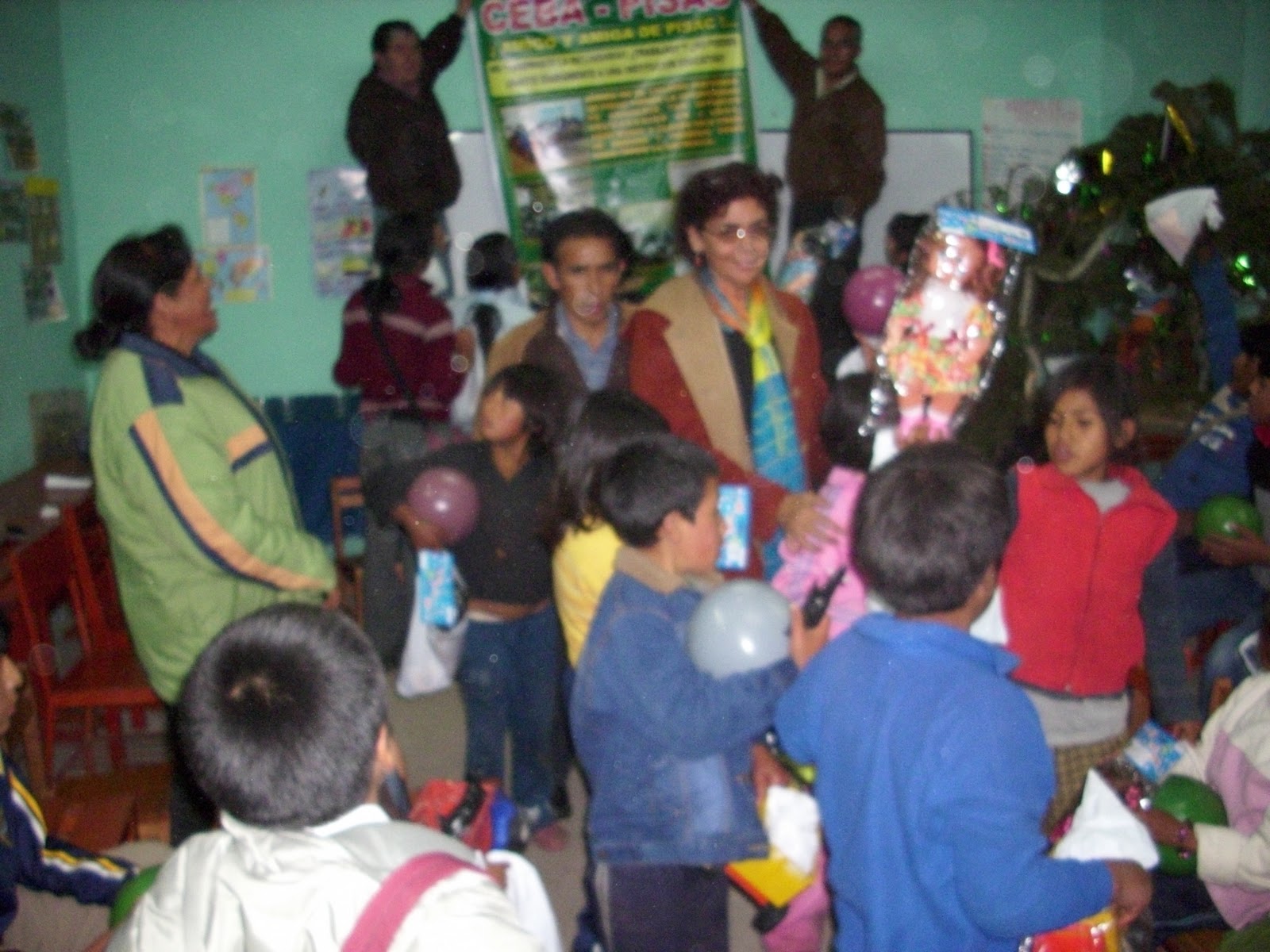
In addition to our participation in the Kusi Kawsay school, Lourdes and I also have a program in which we provide a hot meal on every school night for fifty children in the town of Pisac who attend evening classes after working as domestic servants during the day. These children are mostly orphans or come from families with alcoholic parents who neglect them. The government provides a very minimal education for them in a seperate school from that attended by the rest of the town's children.
We began the program almost four years ago and it has become clear that many children attend the evening classes mainly to get the hot meal living as they do on the margins of society. Since starting the program the children have been attending school on a more regular basis, so it seems that the food is instrumental in ensuring they get an at least minimal education.
We also give each child presents at Christmas time.
Sunday, 19 September 2010
Sixth grade field trip
   |
| Huge adobe walls over volcanic stonework at Raqchi |
- We hired a rather dilapidated bus and headed South. Thirteen students and five adults. The theme was geology and our first stop was a chalk mine where the mineral was burned and turned into white plaster. There are many such mines on the road south of Pisac on the way to the hot springs above Sicuani on the Altiplano, our final destination where we spent the night in a primitive hostel after bathing in hot, mineral-rich waters. Along the way we saw how the geology changed with some areas displaying red and yellow rocks, the sign of iron present in the earth. We stopped at Raqchi where the Incas had made use of volcanic pumice to build a huge ceremonial site.
Thursday, 16 September 2010
Woodcarving class
 |
| Senior woodcarvers with lamps they have been making |

Seed planting day
 |
| 6th grade preparing to plant |
Our school is attuned to the ancient agricultural calendar of the Incas and their predecessors by way of getting our students in touch with their ancestral heritage which was for many years repressed by the Spanish colonial system. Today we had a ceremony in which seeds were blessed by all the children in a short ceremony in which thanks were given to Pachamama, who is much more than just 'mother earth'. In the Inca cosmology she is also the feminine principle of the cosmos, her male counterpart being Pachacamac.
 |
| Parent and shaman Rene Franco blessing seeds prior to planting |
Tuesday, 14 September 2010
New Kindergarten Kusi Kawsay Pisac
 |
| The kindergarten now has its grass thatch roof and mud-plaster walls |

Our school is markedly different from the standard Peruvian state schools which are based on a military model. During my first year in Peru I was amazed and appalled to see very young children participating in parades on patriotic holidays dressed in uniform and goose-stepping like German soldiers in the 1940's.
Our school seeks to demonstrate a more peaceful alternative in a modern way, but with roots that stretch back to a time before the people were conquered by the Spanish military and the Church. Five hundred years of forced colonialism have left deep scars in the collective psyche here which we are attempting in a small way to heal.
Our new kindergarten building is rapidly taking shape as seen in the photos above.
Subscribe to:
Posts (Atom)